

ISSN 0439-755X
CN 11-1911/B
CN 11-1911/B
Acta Psychologica Sinica ›› 2026, Vol. 58 ›› Issue (9): 1766-1780.doi: 10.3724/SP.J.1041.2026.1766
• Column on the Stress, Resilience, and Health • Previous Articles Next Articles
DONG Bo1,2,3( ), XIA Zuyu1, ZHANG Ming1,2,4()
Published:2026-09-25
Online:2026-07-29
Contact:
DONG Bo, E-mail: dongb283@126.com; ZHANG Ming, E-mail: psyzm@suda.edu.cn
DONG Bo, XIA Zuyu, ZHANG Ming. (2026). Stimulus dependence of neural sites for binocular rivalry. Acta Psychologica Sinica, 58(9), 1766-1780.
Add to citation manager EndNote|Ris|BibTeX
URL: https://journal.psych.ac.cn/acps/EN/10.3724/SP.J.1041.2026.1766
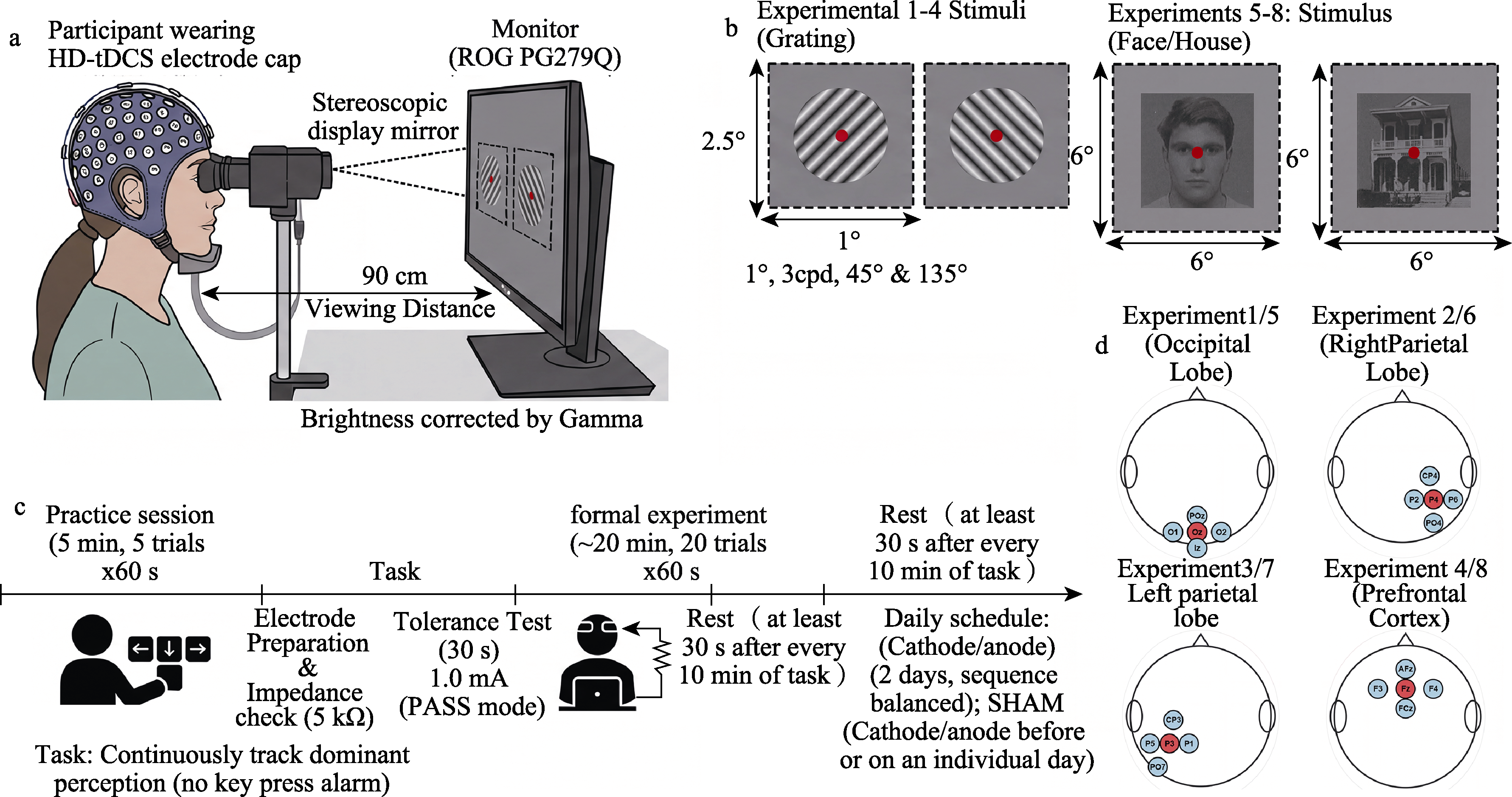
Figure 1. Schematic diagram of the experimental stimuli and procedure. Note: (a) A participant wearing the HD-tDCS electrode cap, viewing a gammacorrected monitor at a distance of 89.90 cm through a planar stereoscope. (b) Visual stimuli: Experiments 1~4 used gratings (1°, 3 cpd, 45°/135°); Experiments 5~8 used face/house images (6°). The red dot indicates the fixation point. (c) Experimental procedure: practice (5 min) → electrode preparation (impedance < 5 kΩ) → pre-stimulation (i.e., tolerance test; 30 s, 1.00 mA) → formal experiment (approx. 20 min) → rest. Cathodal or anodal stimulation sessions were conducted on separate days (order counterbalanced); sham stimulation could be performed on the same day as anodal/cathodal stimulation (but always preceding it) or on a separate day. (d) 4×1 ring HD-tDCS electrode configuration: the centre electrode (red) was placed at Oz (occipital lobe, Experiments 1/5), P4 (right parietal lobe, Experiments 2/6), P3 (left parietal lobe, Experiments 3/7), and Fz (frontal lobe, Experiments 4/8), with surrounding return electrodes (blue) arranged around them. Electrode positions followed the international 10-10 system. Colour figures are available in the electronic version; the same applies to subsequent figures
| Experiment | Eye dominance strength | Perceptual alternation rate | ||||
|---|---|---|---|---|---|---|
| Anodal | Cathodal | Sham | Anodal | Cathodal | Sham | |
| Exp 1 | 3.20 ± 2.37 | 7.81 ± 2.37 | 9.03 ± 1.71 | 0.33 ± 0.02 | 0.40 ± 0.05 | 0.38 ± 0.04 |
| Exp 2 | 6.08 ± 1.52 | 7.50 ± 1.49 | 9.95 ± 1.47 | 0.29 ± 0.03 | 0.34 ± 0.04 | 0.30 ± 0.03 |
| Exp 3 | 10.10 ± 1.67 | 11.03 ± 2.64 | 10.13 ± 1.86 | 0.45 ± 0.05 | 0.47 ± 0.06 | 0.42 ± 0.04 |
| Exp 4 | 6.49 ± 1.64 | 5.80 ± 1.91 | 7.64 ± 1.36 | 0.42 ± 0.04 | 0.42 ± 0.06 | 0.41 ± 0.04 |
| Exp 5 | 8.30 ± 1.47 | 7.57 ± 1.98 | 8.81 ± 1.59 | 0.23 ± 0.03 | 0.23 ± 0.03 | 0.22 ± 0.03 |
| Exp 6 | 5.56 ± 1.71 | 4.13 ± 1.21 | 5.24 ± 1.13 | 0.35 ± 0.04 | 0.33 ± 0.03 | 0.31 ± 0.03 |
| Exp 7 | 5.26 ± 1.27 | 5.15 ± 1.06 | 7.22 ± 1.13 | 0.24 ± 0.03 | 0.26 ± 0.03 | 0.24 ± 0.03 |
| Exp 8 | 2.79 ± 0.89 | 4.56 ± 0.84 | 5.27 ± 0.76 | 0.25 ± 0.04 | 0.25 ± 0.04 | 0.24 ± 0.03 |
Table 1 Means and standard errors of eye dominance strength and perceptual alternation rate for Experiments 1~8.
| Experiment | Eye dominance strength | Perceptual alternation rate | ||||
|---|---|---|---|---|---|---|
| Anodal | Cathodal | Sham | Anodal | Cathodal | Sham | |
| Exp 1 | 3.20 ± 2.37 | 7.81 ± 2.37 | 9.03 ± 1.71 | 0.33 ± 0.02 | 0.40 ± 0.05 | 0.38 ± 0.04 |
| Exp 2 | 6.08 ± 1.52 | 7.50 ± 1.49 | 9.95 ± 1.47 | 0.29 ± 0.03 | 0.34 ± 0.04 | 0.30 ± 0.03 |
| Exp 3 | 10.10 ± 1.67 | 11.03 ± 2.64 | 10.13 ± 1.86 | 0.45 ± 0.05 | 0.47 ± 0.06 | 0.42 ± 0.04 |
| Exp 4 | 6.49 ± 1.64 | 5.80 ± 1.91 | 7.64 ± 1.36 | 0.42 ± 0.04 | 0.42 ± 0.06 | 0.41 ± 0.04 |
| Exp 5 | 8.30 ± 1.47 | 7.57 ± 1.98 | 8.81 ± 1.59 | 0.23 ± 0.03 | 0.23 ± 0.03 | 0.22 ± 0.03 |
| Exp 6 | 5.56 ± 1.71 | 4.13 ± 1.21 | 5.24 ± 1.13 | 0.35 ± 0.04 | 0.33 ± 0.03 | 0.31 ± 0.03 |
| Exp 7 | 5.26 ± 1.27 | 5.15 ± 1.06 | 7.22 ± 1.13 | 0.24 ± 0.03 | 0.26 ± 0.03 | 0.24 ± 0.03 |
| Exp 8 | 2.79 ± 0.89 | 4.56 ± 0.84 | 5.27 ± 0.76 | 0.25 ± 0.04 | 0.25 ± 0.04 | 0.24 ± 0.03 |
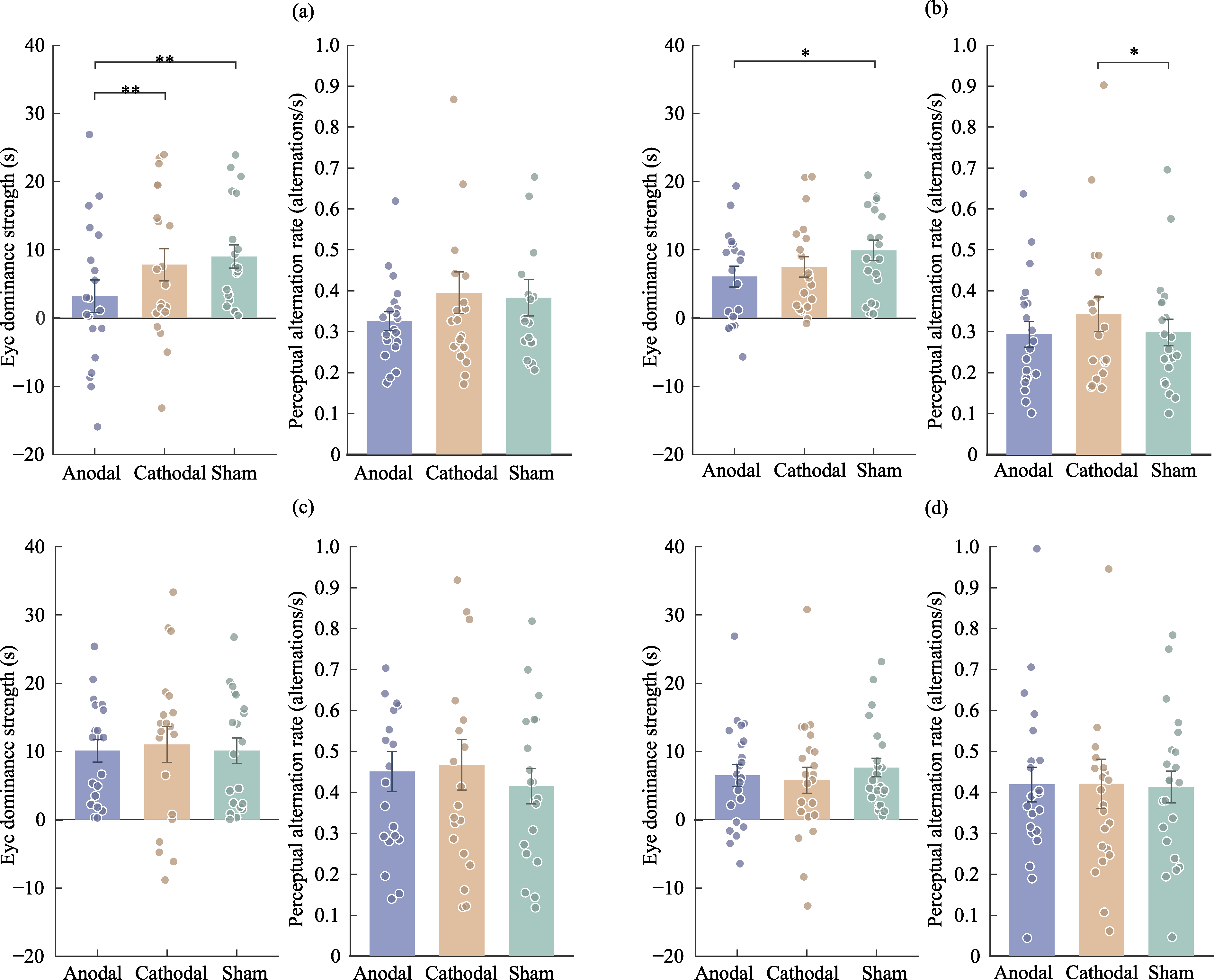
Figure 2. Effects of transcranial direct current stimulation (tDCS) over different brain regions on binocular rivalry with grating stimuli. Note: (a) Experiment 1: intervention over the occipital lobe; (b) Experiment 2: intervention over the right parietal lobe; (c) Experiment 3: intervention over the left parietal lobe; (d) Experiment 4: intervention over the frontal lobe. The left y-axis represents eye dominance strength, defined as the difference between the dominance duration of the dominant eye and that of the non-dominant eye (unit: seconds). The right y-axis represents perceptual alternation rate, defined as the number of perceptual state switches per unit time (unit: alternations per second). On the x-axis, Anodal denotes the anodal stimulation condition, Cathodal denotes the cathodal stimulation condition, and Sham denotes the sham (placebo) condition. Significance markers: * p < 0.05, ** p < 0.01; post-hoc comparisons were performed using paired-samples t-tests with Holm correction for multiple comparisons. Bars represent group means under each condition; error bars indicate the standard error of the mean (SE). Scatter points represent individual participant data.

Figure 3. Effects of transcranial direct current stimulation (tDCS) over different brain regions on binocular rivalry with face/house stimuli. Note: (a) Experiment 5: intervention over the occipital lobe; (b) Experiment 6: intervention over the right parietal lobe; (c) Experiment 7: intervention over the left parietal lobe; (d) Experiment 8: intervention over the frontal lobe. The left y-axis represents eye dominance strength, defined as the difference between the dominance duration of the dominant eye and that of the non-dominant eye (unit: seconds). The right y-axis represents perceptual alternation rate, defined as the number of perceptual state switches per unit time (unit: alternations per second). On the x-axis, Anodal denotes the anodal stimulation condition, Cathodal denotes the cathodal stimulation condition, and Sham denotes the sham (placebo) condition. Significance markers: * p < 0.05, ** p < 0.01; post-hoc comparisons were performed using paired-samples t-tests with Holm correction for multiple comparisons. Bars represent group means under each condition; error bars indicate the standard error of the mean (SE). Scatter points represent individual participant data.
| Indicator type | Brain region | Anodal vs. Sham (Cohen’s d [95% CI for mean difference]) | Cathodal vs. Sham (Cohen’s d [95% CI for the mean difference]) | ||
|---|---|---|---|---|---|
| Gratings | Faces/Houses | Gratings | Faces/Houses | ||
| Eye dominance strength | Occipital lobe | ?0.82[?9.18, ?2.49] | ?0.12[?2.63, 1.60] | ?0.15[?5.01, 2.57] | ?0.25[?3.71, 1.23] |
| Right parietal lobe | ?0.73[?6.35, ?1.39] | 0.07[?1.95, 2.60] | ?0.44[?5.05, 0.15] | ?0.28[?2.96, 0.75] | |
| Left parietal lobe | ?0.01[?2.09, 2.01] | ?0.56[?3.61, ?0.31] | 0.12[?2.50, 4.30] | ?0.63[?3.63, ?0.53] | |
| Frontal lobe | ?0.21[?3.58, 1.28] | ?0.64[?4.30, ?0.66] | ?0.28[?4.74, 1.06] | ?0.17[?2.73, 1.30] | |
| Perceptual alternation rate | Occipital lobe | ?0.36[?0.13, 0.02] | 0.15[?0.02, 0.03] | 0.09[?0.05, 0.08] | 0.23[?0.01, 0.03] |
| Right parietal lobe | ?0.05[?0.04, 0.03] | 0.59[0.01, 0.06] | 0.60[0.01, 0.08] | 0.25[?0.01, 0.05] | |
| Left parietal lobe | 0.24[?0.03, 0.10] | 0.03[?0.04, 0.04] | 0.36[?0.02, 0.12] | 0.32[?0.01, 0.05] | |
| Frontal lobe | 0.06[?0.04, 0.05] | 0.10[?0.02, 0.03] | 0.05[?0.06, 0.08] | 0.35[?0.01, 0.03] | |
Table 2 Cross-experiment comparison of effect sizes.
| Indicator type | Brain region | Anodal vs. Sham (Cohen’s d [95% CI for mean difference]) | Cathodal vs. Sham (Cohen’s d [95% CI for the mean difference]) | ||
|---|---|---|---|---|---|
| Gratings | Faces/Houses | Gratings | Faces/Houses | ||
| Eye dominance strength | Occipital lobe | ?0.82[?9.18, ?2.49] | ?0.12[?2.63, 1.60] | ?0.15[?5.01, 2.57] | ?0.25[?3.71, 1.23] |
| Right parietal lobe | ?0.73[?6.35, ?1.39] | 0.07[?1.95, 2.60] | ?0.44[?5.05, 0.15] | ?0.28[?2.96, 0.75] | |
| Left parietal lobe | ?0.01[?2.09, 2.01] | ?0.56[?3.61, ?0.31] | 0.12[?2.50, 4.30] | ?0.63[?3.63, ?0.53] | |
| Frontal lobe | ?0.21[?3.58, 1.28] | ?0.64[?4.30, ?0.66] | ?0.28[?4.74, 1.06] | ?0.17[?2.73, 1.30] | |
| Perceptual alternation rate | Occipital lobe | ?0.36[?0.13, 0.02] | 0.15[?0.02, 0.03] | 0.09[?0.05, 0.08] | 0.23[?0.01, 0.03] |
| Right parietal lobe | ?0.05[?0.04, 0.03] | 0.59[0.01, 0.06] | 0.60[0.01, 0.08] | 0.25[?0.01, 0.05] | |
| Left parietal lobe | 0.24[?0.03, 0.10] | 0.03[?0.04, 0.04] | 0.36[?0.02, 0.12] | 0.32[?0.01, 0.05] | |
| Frontal lobe | 0.06[?0.04, 0.05] | 0.10[?0.02, 0.03] | 0.05[?0.06, 0.08] | 0.35[?0.01, 0.03] | |
| [1] |
Abuleil D., McCulloch D., & Thompson B. (2021). Visual cortex cTBS increases mixed percept duration while a-tDCS has no effect on binocular rivalry. PLoS One, 16(2), e0239349. https://doi. org/10.1371/journal.pone.0239349
doi: 10.1371/journal.pone.0239349 URL |
| [2] |
Alais D., & Melcher D. (2007). Strength and coherence of binocular rivalry depends on shared stimulus complexity. Vision Research, 47(2), 269-279. https://doi.org/10.1016/j.visres.2006.09.003
URL pmid: 17049579 |
| [3] |
Andrews T. J., & Purves D. (1997). Similarities in normal and binocularly rivalrous viewing. Proceedings of the National Academy of Sciences, 94(18), 9905-9908. https://doi.org/10.1073/pnas.94.18. 9905
doi: 10.1073/pnas.94.18.9905 URL |
| [4] | Antal A., Kincses T. Z., Nitsche M. A., Bartfai O., & Paulus W. (2004). Excitability changes induced in the human primary visual cortex by transcranial direct current stimulation: Direct electrophysiological evidence. Investigative Ophthalmology & Visual Science, 45(2), 702-707. https://doi.org/10.1167/iovs.03-0688 |
| [5] |
Bjekić J., Čolić M. V., Živanović M., Milanović S. D., & Filipović S. R. (2019). Transcranial direct current stimulation (tDCS) over parietal cortex improves associative memory. Neurobiology of Learning and Memory, 157, 114-120. https://doi.org/10.1016/j.nlm. 2018.12.007
doi: S1074-7427(18)30283-1 URL pmid: 30553021 |
| [6] |
Blake R. (1989). A neural theory of binocular rivalry. Psychological Review, 96(1), 145-167. https://doi.org/10.1037/0033-295X.96.1.145
doi: 10.1037/0033-295x.96.1.145 URL pmid: 2648445 |
| [7] |
Blake R., & Logothetis N. K. (2002). Visual competition. Nature Reviews Neuroscience, 3(1), 13-21. https://doi.org/10.1038/nrn701
doi: 10.1038/nrn701 URL pmid: 11823801 |
| [8] |
Blake R., Sobel K. V., & Gilroy L. A. (2003). Visual motion retards alternations between conflicting perceptual interpretations. Neuron, 39(5), 869-878. https://doi.org/10.1016/S0896-6273(03)00495-1
URL pmid: 12948452 |
| [9] |
Blake R., Tadin D., Sobel K. V., Raissian T. A., & Chong S. C. (2006). Strength of early visual adaptation depends on visual awareness. Proceedings of the National Academy of Sciences, 103(12), 4783-4788. https://doi.org/10.1073/pnas.0509634103
doi: 10.1073/pnas.0509634103 URL |
| [10] |
Brascamp J., Sterzer P., Blake R., & Knapen T. (2018). Multistable perception and the role of the frontoparietal cortex in perceptual inference. Annual Review of Psychology, 69, 77-103. https://doi. org/10.1146/annurev-psych-010417-085944
doi: 10.1146/annurev-psych-010417-085944 URL pmid: 28854000 |
| [11] |
Brascamp J. W., Klink P. C., & Levelt W. J. M. (2015). The ‘laws’ of binocular rivalry: 50 years of Levelt’s propositions. Vision Research, 109(Part A), 20-37. https://doi.org/10.1016/j.visres.2015.02.019
doi: 10.1016/j.visres.2015.02.019 URL |
| [12] | Carmel D., Walsh V., Lavie N., & Rees G. (2010). Right parietal TMS shortens dominance durations in binocular rivalry. Current Biology, 20(18), R799-R800. https://doi.org/10.1016/j.cub.2010. 07.036 |
| [13] |
Carter O. L., & Pettigrew J. D. (2003). A common oscillator for perceptual rivalries? Perception, 32(3), 295-305. https://doi.org/10. 1068/p3472
URL pmid: 12729381 |
| [14] |
Chen X., Bobier W., & Thompson B. (2023). Short-term ocular dominance plasticity is not modulated by visual cortex tDCS but increases with length of monocular deprivation. Scientific Reports, 13(1), 6666. https://doi.org/10.1038/s41598-023-33823-7
doi: 10.1038/s41598-023-33823-7 URL |
| [15] | Dieter K. C., & Tadin D. (2011). Understanding attentional modulation of binocular rivalry: A framework based on biased competition. Frontiers in Human Neuroscience, 5, Article 155. https://doi.org/10. 3389/fnhum.2011.00155 |
| [16] |
Faul F., Erdfelder E., Buchner A., & Lang A.-G. (2009). Statistical power analyses using G*Power 3.1: Tests for correlation and regression analyses. Behavior Research Methods, 41(4), 1149-1160. https://doi.org/10.3758/BRM.41.4.1149
doi: 10.3758/BRM.41.4.1149 URL pmid: 19897823 |
| [17] |
Faul F., Erdfelder E., Lang A.-G., & Buchner A. (2007). G*Power 3: A flexible statistical power analysis program for the social, behavioral, and biomedical sciences. Behavior Research Methods, 39(2), 175-191. https://doi.org/10.3758/BF03193146
doi: 10.3758/bf03193146 URL pmid: 17695343 |
| [18] |
Frässle S., Sommer J., Jansen A., Naber M., & Einhäuser W. (2014). Binocular rivalry: Frontal activity relates to introspection and action but not to perception. Journal of Neuroscience, 34(5), 1738-1747. https://doi.org/10.1523/JNEUROSCI.4403-13.2014
doi: 10.1523/JNEUROSCI.4403-13.2014 URL pmid: 24478356 |
| [19] |
Hancock S., & Andrews T. J. (2007). The role of voluntary and involuntary attention in selecting perceptual dominance during binocular rivalry. Perception, 36(2), 288-298. https://doi.org/10.1068/p5494
doi: 10.1068/p5494 URL pmid: 17402669 |
| [20] |
Kanai R., Bahrami B., & Rees G. (2010). Human parietal cortex structure predicts individual differences in perceptual rivalry. Current Biology, 20(18), 1626-1630. https://doi.org/10.1016/j.cub. 2010.07.027
doi: 10.1016/j.cub.2010.07.027 URL pmid: 20727757 |
| [21] |
Keogh R., Bergmann J., & Pearson J. (2020). Cortical excitability controls the strength of mental imagery. eLife, 9, e50232. https://doi.org/10.7554/eLife.50232
doi: 10.7554/eLife.50232 URL |
| [22] |
Knapen T., Brascamp J., Pearson J., van Ee R., & Blake R. (2011). The role of frontal and parietal brain areas in bistable perception. Journal of Neuroscience, 31(28), 10293-10301. https://doi.org/10. 1523/JNEUROSCI.1727-11.2011
doi: 10.1523/JNEUROSCI.1727-11.2011 URL pmid: 21753006 |
| [23] |
Lack L. C. (1974). Selective attention and the control of binocular rivalry. Perception & Psychophysics, 15(1), 193-200. https://doi. org/10.3758/BF03205846
doi: 10.3758/BF03205846 URL |
| [24] |
Lehky S. R. (1988). An astable multivibrator model of binocular rivalry. Perception, 17(2), 215-228. https://doi.org/10.1068/p170215
URL pmid: 3067209 |
| [25] |
Leopold D. A., & Logothetis N. K. (1996). Activity changes in early visual cortex reflect monkeys' percepts during binocular rivalry. Nature, 379(6565), 549-553. https://doi.org/10.1038/379549a0
doi: 10.1038/379549a0 URL |
| [26] |
Logothetis N. K., Leopold D. A., & Sheinberg D. L. (1996). What is rivalling during binocular rivalry? Nature, 380(6575), 621-624. https://doi.org/10.1038/380621a0
doi: 10.1038/380621a0 URL |
| [27] |
Logothetis N. K., & Schall J. D. (1989). Neuronal correlates of subjective visual perception. Science, 245(4919), 761-763. https://doi.org/10.1126/science.2772635
URL pmid: 2772635 |
| [28] |
Lumer E. D., Friston K. J., & Rees G. (1998). Neural correlates of perceptual rivalry in the human brain. Science, 280(5371), 1930-1934. https://doi.org/10.1126/science.280.5371.1930
doi: 10.1126/science.280.5371.1930 URL pmid: 9632390 |
| [29] |
Lumer E. D., & Rees G. (1999). Covariation of activity in visual and prefrontal cortex associated with subjective visual perception. Proceedings of the National Academy of Sciences, 96(4), 1669-1673. https://doi.org/10.1073/pnas.96.4.1669
doi: 10.1073/pnas.96.4.1669 URL |
| [30] |
Manojlović M., Bjekić J., Purić D., & Filipović S. R. (2025). High-density theta oscillatory-modulated tDCS over the parietal cortex for targeted memory enhancement. Clinical Neurophysiology, 170, 80-90. https://doi.org/10.1016/j.clinph.2024.12.004
doi: 10.1016/j.clinph.2024.12.004 URL pmid: 39700630 |
| [31] |
Miller S. M., Liu G. B., Ngo T. T., Hooper G., Riek S., Carson R. G., & Pettigrew J. D. (2000). Interhemispheric switching mediates perceptual rivalry. Current Biology, 10(7), 383-392. https://doi.org/ 10.1016/S0960-9822(00)00416-4
doi: 10.1016/S0960-9822(00)00416-4 URL |
| [32] |
Pearson J., & Brascamp J. (2008). Sensory memory for ambiguous vision. Trends in Cognitive Sciences, 12(9), 334-341. https://doi. org/10.1016/j.tics.2008.05.006
doi: 10.1016/j.tics.2008.05.006 URL pmid: 18684661 |
| [33] | Pearson J., Tadin D., & Blake R. (2007). The effects of transcranial magnetic stimulation on visual rivalry. Journal of Vision, 7(7), 2. https://doi.org/10.1167/7.7.2 |
| [34] |
Polanía R., Nitsche M. A., & Ruff C. C. (2018). Studying and modifying brain function with non-invasive brain stimulation. Nature Neuroscience, 21(2), 174-187. https://doi.org/10.1038/s41593-017- 0054-4
doi: 10.1038/s41593-017-0054-4 URL pmid: 29311747 |
| [35] |
Polonsky A., Blake R., Braun J., & Heeger D. J. (2000). Neuronal activity in human primary visual cortex correlates with perception during binocular rivalry. Nature Neuroscience, 3(11), 1153-1159. https://doi.org/10.1038/80676
doi: 10.1038/80676 URL pmid: 11036274 |
| [36] |
Rees G., Kreiman G., & Koch C. (2002). Neural correlates of consciousness in humans. Nature Reviews Neuroscience, 3(4), 261-270. https://doi.org/10.1038/nrn783
URL pmid: 11967556 |
| [37] |
Reinhart R. M. G., & Woodman G. F. (2014). Causal control of medial-frontal cortex governs electrophysiological and behavioral indices of performance monitoring and learning. The Journal of Neuroscience, 34(12), 4214-4227. https://doi.org/10.1523/jneurosci. 5421-13.2014
doi: 10.1523/JNEUROSCI.5421-13.2014 URL |
| [38] |
Sheinberg D. L., & Logothetis N. K. (1997). The role of temporal cortical areas in perceptual organization. Proceedings of the National Academy of Sciences, 94(7), 3408-3413. https://doi.org/ 10.1073/pnas.94.7.3408
doi: 10.1073/pnas.94.7.3408 URL |
| [39] |
Shi L., Sun Z., Woodman G. F., Zhang P., & He S. (2019). Lateralized occipitotemporal tDCS modulates dynamics of binocular rivalry between faces and words. Journal of Vision, 19(10), 62b. https://doi.org/10.1167/19.10.62b
doi: 10.1167/19.10.62b URL |
| [40] |
Sterzer P., Kleinschmidt A., & Rees G. (2009). The neural bases of multistable perception. Trends in Cognitive Sciences, 13(7), 310-318. https://doi.org/10.1016/j.tics.2009.04.006
doi: 10.1016/j.tics.2009.04.006 URL pmid: 19540794 |
| [41] |
Tong F., & Engel S. A. (2001). Interocular rivalry revealed in the human cortical blind-spot representation. Nature, 411(6834), 195-199. https://doi.org/10.1038/35075583
doi: 10.1038/35075583 URL |
| [42] |
Tong F., Meng M., & Blake R. (2006). Neural bases of binocular rivalry. Trends in Cognitive Sciences, 10(11), 502-511. https://doi. org/10.1016/j.tics.2006.09.003
URL pmid: 16997612 |
| [43] |
Tong F., Nakayama K., Vaughan J. T., & Kanwisher N. (1998). Binocular rivalry and visual awareness in human extrastriate cortex. Neuron, 21(4), 753-759. https://doi.org/10.1016/S0896-6273(00) 80592-9
URL pmid: 9808462 |
| [44] |
Tsuchiya N., Wilke M., Frässle S., & Lamme V. A. (2015). No-report paradigms: extracting the true neural correlates of consciousness. Trends in Cognitive Sciences, 19(12), 757-770. https://doi.org/ 10.1016/j.tics.2015.10.002
doi: S1364-6613(15)00252-1 URL pmid: 26585549 |
| [45] |
van Ee R., van Dam L. C. J., & Brouwer G. J. (2005). Voluntary control and the dynamics of perceptual bi-stability. Vision Research, 45(1), 41-55. https://doi.org/10.1016/j.visres.2004.07.030
URL pmid: 15571737 |
| [46] | Villamar M. F., Volz M. S., Bikson M., Datta A., Dasilva A. F., & Fregni F. (2013). Technique and considerations in the use of 4x1 ring high-definition transcranial direct current stimulation (HD-tDCS). Journal of Visualized Experiments, (77), e50309. https://doi.org/10.3791/50309 |
| [47] |
Wilson H. R. (2003). Computational evidence for a rivalry hierarchy in vision. Proceedings of the National Academy of Sciences, 100(24), 14499-14503. https://doi.org/10.1073/pnas.2333622100
doi: 10.1073/pnas.2333622100 URL |
| [48] |
Wilson H. R., Blake R., & Lee S.-H. (2001). Dynamics of travelling waves in visual perception. Nature, 412(6850), 907-910. https://doi. org/10.1038/35091066
doi: 10.1038/35091066 URL |
| [49] |
Zaretskaya N., Thielscher A., Logothetis N. K., & Bartels A. (2010). Disrupting parietal function prolongs dominance durations in binocular rivalry. Current Biology, 20(23), 2106-2111. https://doi. org/10.1016/j.cub.2010.10.046
doi: 10.1016/j.cub.2010.10.046 URL pmid: 21093263 |
| [50] |
Zhang P., Jamison K., Engel S., He B., & He S. (2011). Binocular rivalry requires visual attention. Neuron, 71(2), 362-369. https://doi. org/10.1016/j.neuron.2011.05.035
doi: 10.1016/j.neuron.2011.05.035 URL pmid: 21791293 |
| [1] | HUA Yan, LI Mingxia, WANG Qiaoting, FENG Caixia, ZHANG Jing. The role of left orbitofrontal cortex in selective attention during automatic emotion regulation: Evidence from transcranial direct current stimulation [J]. Acta Psychologica Sinica, 2020, 52(9): 1048-1056. |
| [2] | YIN Xile, LI Jianbiao, CHEN Siyu, LIU Xiaoli, HAO Jie. Neural mechanisms of third-party punishment: Evidence from transcranial direct current stimulation [J]. Acta Psychologica Sinica, 2019, 51(5): 571-583. |
| [3] | Junchen SHANG, Zhihui LIU, Wenfeng CHEN, Xiaolan FU. Influence of aesthetics on unconscious processing of western paintings [J]. Acta Psychologica Sinica, 2018, 50(7): 693-702. |
| [4] | Sisi WANG, Yixuan KU. The causal role of right dorsolateral prefrontal cortex in visual working memory [J]. Acta Psychologica Sinica, 2018, 50(7): 727-738. |
| [5] | Hui Hui WANG, Yu Dan LUO, Bing SHI, Feng Qiong YU, Kai WANG. Excitation of the right dorsolateral prefrontal cortex with transcranial direct current stimulation influences response inhibition [J]. Acta Psychologica Sinica, 2018, 50(6): 647-654. |
| [6] | GAN Tian, SHI Rui, LIU Chao, LUO Yuejia. Cathodal transcranial direct current stimulation on the right temporo-parietal junction modulates the helpful intention processing [J]. Acta Psychologica Sinica, 2018, 50(1): 36-46. |
| [7] | GAN Tian;LI Wanqing;TANG Honghong;LU Xiaping;LI Xiaoli;LIU Chao;LUO Yuejia. Exciting the Right Temporo-Parietal Junction with Transcranial Direct Current Stimulation Influences Moral Intention Processing [J]. Acta Psychologica Sinica, 2013, 45(9): 1004-1014. |
| [8] | ZHANG Xiu-Ling;DONG Bo;JIANG Yun-Peng;ZHANG Ming. The Gestalt in Unconscious Processing: Evidence for the Unconscious Binding Hypothesis [J]. Acta Psychologica Sinica, 2012, 44(12): 1563-1570. |
| Viewed | ||||||
|
Full text |
|
|||||
|
Abstract |
|
|||||
